The smart home industry is not moving forward in a straight line. It’s looping back on itself.
What we’re seeing right now is not innovation.
Disclosure: This post may contain affiliate links. If you buy through these links, Trunetto may earn a commission at no extra cost to you.
The smart home industry is not moving forward in a straight line. It’s looping back on itself.
What we’re seeing right now is not innovation for its own sake, but correction after a decade of optimistic shortcuts.
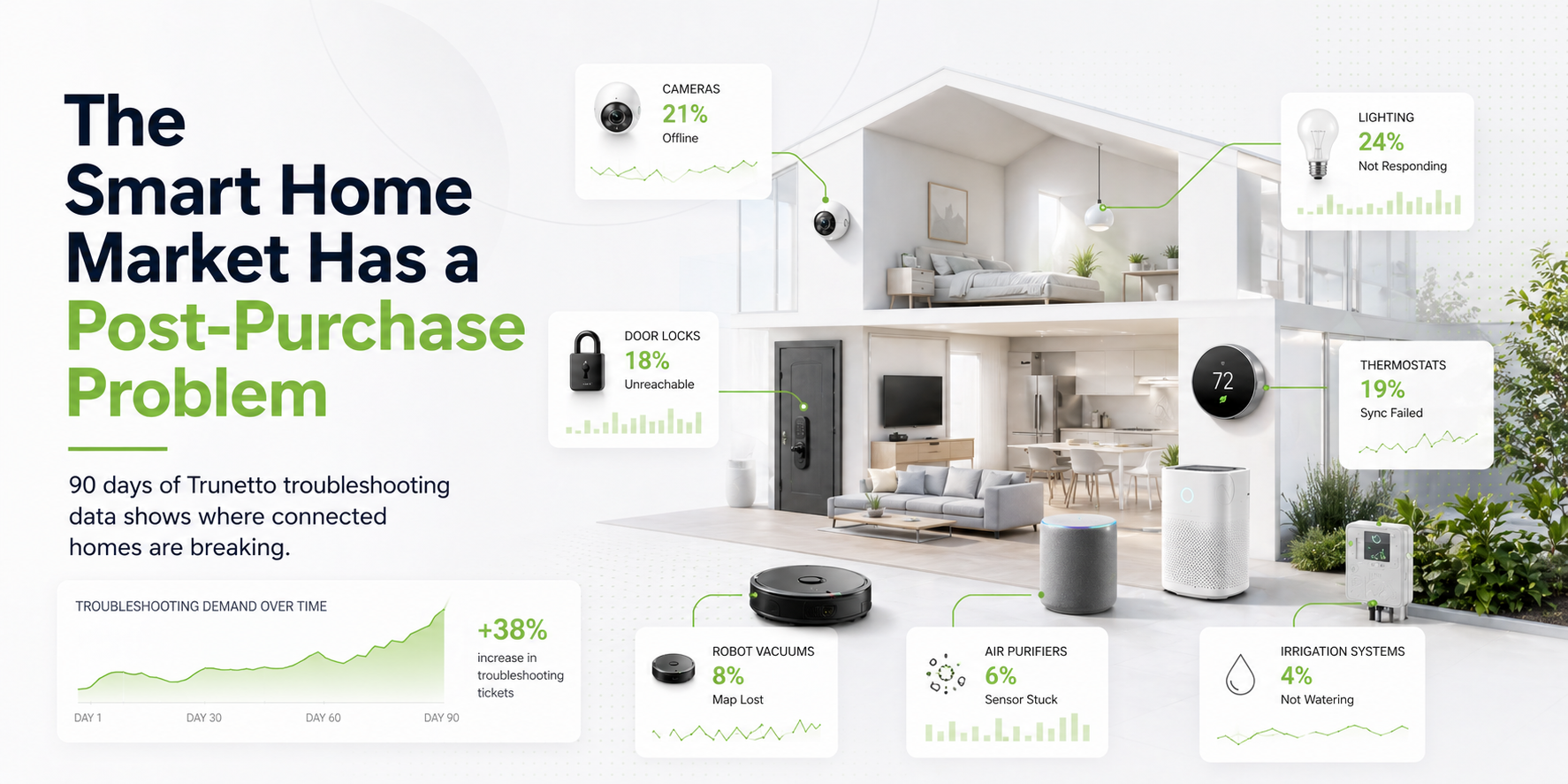
Most homeowners don’t experience smart home failure as a dramatic collapse. They experience it as erosion.
Things get slower. Devices hesitate. Automations stop feeling trustworthy.
Eventually, confidence disappears.
That erosion explains nearly every “new” development in home automation right now.
Not because the technology is suddenly brilliant, but because the cost of unreliability finally became impossible to ignore.
The Shift From Features to Reliability
For years, the industry optimised for feature velocity. More integrations, more apps, more compatibility badges.
Reliability was assumed, not designed.
Homes were treated like consumer gadgets instead of long-lived systems.
That worked while device counts were low. It stopped working the moment homes filled with dozens of always-on endpoints.
What’s changed now is not consumer taste, but tolerance.
People no longer accept that lights “sometimes” respond or that locks “usually” work.
Reliability has become the baseline expectation, not a premium feature.
Matter as a Market Correction, Not a Breakthrough
Matter didn’t arrive because consumers demanded a new standard.
It arrived because fragmentation became commercially unsustainable.
Ecosystem lock-in stopped looking like differentiation and started looking like friction.
Every incompatible device was another support ticket, return, or abandoned platform.
Matter doesn’t make devices better. It makes the market less hostile.
Its value is not immediate delight, but long-term stability.
That’s why it feels underwhelming to people expecting a dramatic upgrade.
Thread and the Quiet Re-Architecture of the Home
Thread exists for the same reason Matter does: admission.
Not public, not explicit, but undeniable.
The industry finally accepted that Wi-Fi was being used as a universal transport when it shouldn’t have been.
Low-power, latency-sensitive devices were competing with high-bandwidth traffic and losing.
Thread introduces separation. Not everything belongs on the same network.
That idea alone is more important than any specific protocol detail.
Why Energy Automation Is Finally Working
Energy automation failed for years because it required attention.
Dashboards asked users to care, configure, and constantly interpret data.
Most people didn’t.
What’s changing now is that energy logic is becoming implicit.
Systems react to presence, pricing, and thermal behaviour without requiring supervision.
The result is not excitement, but quiet savings.
And quiet savings are the only kind that scale.
Local Control and the End of Blind Cloud Dependence
The return of local control is not ideological.
It’s practical.
Cloud-only systems turned minor outages into system-wide failures.
Homes lost basic functionality because services elsewhere had issues.
The industry is slowly relearning that a home must function independently first,
and integrate externally second.
What Actually Matters Going Forward
What matters now is not chasing novelty.
It’s understanding which parts of the system must be boring.
Homes that last will be designed around separation, local decision-making,
and clear boundaries between reliability-critical and convenience-driven components.
This is not a glamorous phase for home automation.
But it’s the one that determines whether the category grows up or collapses under its own weight.
That’s the real Tech Pulse.
Not what’s loud, but what’s being quietly fixed.