Govee TV Backlight 3 Lite vs 3 Pro (2026): Which One Should You Buy?
The 3 Pro targets higher-end sync performance, while the 3 Lite remains the lower-cost option for most setups.

Trunetto is a participant in the Amazon Services LLC Associates Program. We earn a commission from qualifying purchases at no additional cost to you. Our editorial picks are independent.
If you are choosing between Govee TV Backlight 3 Lite and 3 Pro, focus on feature differences first: camera generation, sync processing tier, and pricing. The 3 Pro is positioned as the premium model, while the Lite is designed as the value-first option for everyday movie and gaming use.
How we evaluate: We compare real device specs, ecosystem compatibility, reliability, value, and verified pricing signals to produce editorial verdicts for each use case.
Key Differences at a Glance
| Decision Factor | Govee TV Backlight 3 Lite | Govee TV Backlight 3 Pro |
|---|---|---|
| Price (Latest Verified) | $114.99 (verified Jul 23) | $179.99 (verified Jul 23) |
| Connectivity Stack | Wi-Fi | Wi-Fi, Matter |
| Smart Home Ecosystem Support | Alexa, Google | Alexa, Google, Apple Home |
| Matter Support | No | Yes |
How We Tested
We score each product using weighted criteria based on real-world ownership outcomes, then combine those factors into a normalized editorial view.
Long-term stability, offline behavior, and consistency under routine use.
Automation depth, app controls, integrations, and hardware capability.
Install friction, onboarding quality, and day-to-day usability.
Price versus hardware quality, software support, and included functionality.
Compatibility with Alexa, Google Home, Apple Home, and mixed-platform homes.
Current weighted leader: Govee TV Backlight 3 Pro (8.8/10).
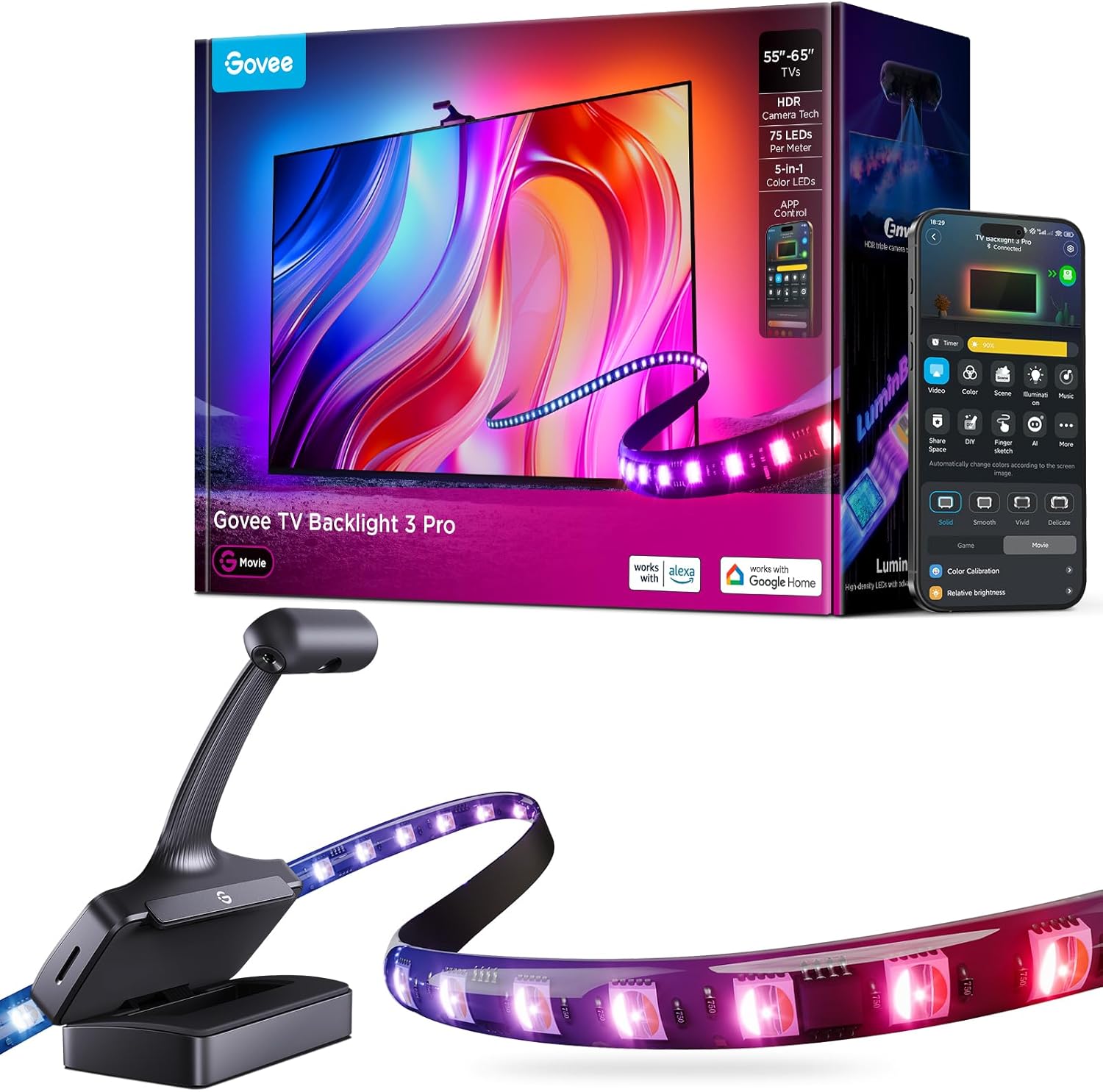
The TV Backlight 3 Pro is the better product in almost every measurable way - a triple-lens camera for accurate full-screen and HDR tracking, roughly 75 LEDs per meter of 5-in-1 RGBWW light versus about 30 on the Lite, and around 30% more brightness - which makes it the pick for large TVs, bright rooms, and HDR-heavy viewing. But the Lite remains an excellent value: for around $60 less it delivers the same core Ambilight-style immersion, and in a dark room on a mid-size TV most viewers won't miss the Pro's extras. Pay for the Pro if you'll actually use its brightness and HDR accuracy; save with the Lite if you won't.
The 3 Pro is selected as winner here based on higher-tier positioning and feature set, while the Lite remains the stronger value pick on price.
See Best Price on AmazonWho Should Buy What
| Buyer Profile | Best Pick | Why |
|---|---|---|
| Best overall visual quality | Govee TV Backlight 3 Pro | The Pro's triple-lens camera, ~75-LED/meter density, and 16-bit chip deliver more accurate, smoother color. |
| Best on a budget | Govee TV Backlight 3 Lite | The Lite delivers the same core Ambilight-style effect for around $60 less. |
| Best for HDR movies and gaming | Govee TV Backlight 3 Pro | The Pro's triple camera keeps bright and dark areas separated on high-contrast HDR content. |
| Best for bright or lit rooms | Govee TV Backlight 3 Pro | The Pro is about 30% brighter (~337 lumens/meter), staying visible where the Lite washes out. |
| Best for large TVs (65 inch and up) | Govee TV Backlight 3 Pro | The Pro's denser LEDs and triple camera track big and curved screens more accurately. |
At a Glance: Scores
Full Spec Comparison
| Spec | Govee TV Backlight 3 Lite | Govee TV Backlight 3 Pro Our Pick |
|---|---|---|
| Hardware | ||
| Color Mapping Accuracy | Good | Very good |
| HDR Scene Consistency | Moderate | Strong |
| Software | ||
| Setup Difficulty | Easy | Easy |
| App Scene Library | Large | Large |
| Value | ||
| Price | ~$114.99 | ~$179.99 |
| Best For | Budget immersion | Premium fidelity |
| Ecosystem | ||
| Voice Assistant Support | Alexa, Google | Alexa, Google |
Pros & Cons
Govee TV Backlight 3 Lite- Great value for the performance
- Solid immersion for movies and TV
- Simple setup for most users
- Good app scene options
- Less precise in hard HDR scenes
- Can drift in very dark content
- Not as clean in fast transitions
A strong value pick that still looks impressive in everyday use.
Govee TV Backlight 3 Pro Winner- Cleaner HDR and contrast tracking
- More consistent edge mapping
- Better in high-motion content
- Premium output for demanding setups
- Higher price
- Value gap is smaller for casual viewers
The better performer for buyers who care about consistency in tougher content.
Brand Intel
Govee delivers premium smart lighting features at budget prices. RGBIC technology enables individual LED segment control for dynamic effects. Music sync mode reacts to audio in real-time for immersive experiences. DreamView camera syncs lights with TV content. No hub required — WiFi and Bluetooth direct connection.
Govee delivers premium smart lighting features at budget prices. RGBIC technology enables individual LED segment control for dynamic effects. Music sync mode reacts to audio in real-time for immersive experiences. DreamView camera syncs lights with TV content. No hub required — WiFi and Bluetooth direct connection.
Which Is Best For…
The 3 Pro is selected as winner here based on higher-tier positioning and feature set, while the Lite remains the stronger value pick on price.
In-Depth Analysis
The Camera: Triple-Lens Pro vs Single-Lens Lite
Both backlights work the same basic way - a small camera clipped to your TV reads the on-screen colors and mirrors them onto the LED strip behind it. The difference is how well each camera sees. The TV Backlight 3 Pro uses a triple-lens camera system that captures the full screen with far more accuracy, including much finer distinction between bright and dark areas, which is what makes its HDR tracking noticeably better. The Lite uses a single-lens camera - perfectly good for most content, but less precise at the edges and corners and less nuanced on high-contrast HDR scenes. If you watch a lot of HDR movies and games, the Pro's camera is the single biggest reason it looks better.
LED Density: 75 vs ~30 LEDs per Meter
This is the difference you actually see on the wall. The Pro packs about 75 LEDs per meter versus roughly 30 on the Lite - around three and a half times as many light points. More LEDs mean color gradients blend smoothly with no visible gaps or hotspots, and effects travel across the strip more fluidly. The Pro's LEDs are also full 5-in-1 RGBIC beads with dedicated white and warm-white, so whites look clean rather than tinted. The Lite's lower density still gives a pleasant glow, but up close and on larger TVs you can see individual points and coarser transitions.
Brightness: 337 Lumens and Lit-Room Performance
The Pro is roughly 30% brighter than the previous generation, putting out about 337 lumens per meter. In a dim home-theater room both look great, but in a living room with lamps or daylight the Lite's glow can wash out while the Pro still reads clearly against the wall. If your TV lives in a bright, open space, brightness alone is a strong reason to step up to the Pro; if you mostly watch in a darkened room, the Lite's output is plenty.
Color Accuracy: The 16-bit Chip and HDR
The Pro pairs its denser RGBWW LEDs with Govee's 16-bit G1151 processor and an improved color-matching algorithm, so the light on the wall tracks the on-screen color more precisely and shifts more smoothly between tones. Combined with the triple-lens camera, HDR content in particular looks more convincing - deep shadows and bright highlights stay separated instead of averaging into one muddy glow. The Lite's color matching is good, but it renders fewer gradations and can lag slightly on fast, high-contrast scenes.
Sizes and Price: What You Pay
The Lite is the affordable entry at around $120 and covers common TV sizes. The Pro runs about $180 for the 12ft kit that fits 55-65 inch TVs, or roughly $210 for the 16ft kit for 75-85 inch sets - so you pay a meaningful premium, about $60 more at the same size class, for the triple camera, the far denser LEDs, and the extra brightness. On a small-to-mid TV in a dark room that premium is hard to justify; on a large TV in a bright room it's exactly where the Pro earns it.
Setup and Calibration
Both mount the same way: stick the LED strip around the back of the TV, clip the camera to the top or bottom edge, and run a quick calibration in the Govee Home app where you mark the screen corners so the camera knows the boundaries. The Pro's triple-lens camera makes that calibration more forgiving and more accurate across the whole screen, especially on very large or slightly curved TVs where a single lens struggles to see the far corners. Neither is difficult - budget about 20-30 minutes including cable management.
Where the Lite Is Still the Smart Buy
The Pro wins on paper, but the Lite is far from a downgrade. For a bedroom or a mid-size TV, for a first bias-lighting kit, or for anyone who watches mostly in a dark room, the Lite delivers the same core Ambilight-style effect for around sixty dollars less. Most people who aren't scrutinizing HDR highlights side by side will be very happy with it - the Pro's advantages are real but incremental for casual viewing, not night-and-day.
Which Should You Buy
Choose the TV Backlight 3 Pro if you have a large TV (65 inches and up), watch a lot of HDR and gaming, or your TV lives in a bright room - the triple camera, denser 5-in-1 LEDs, and higher brightness are worth the premium there. Choose the TV Backlight 3 Lite if you want the same immersive effect for less, have a small-to-mid TV, or watch mostly in a dark room where the extra brightness and density go unused. Both are among the best Ambilight alternatives available; the Pro is the enthusiast pick, the Lite is the value pick.
Current Prices & Where to Buy
* Prices may vary. We earn a small commission from Amazon purchases at no extra cost to you. This helps fund our independent reviews.